EN
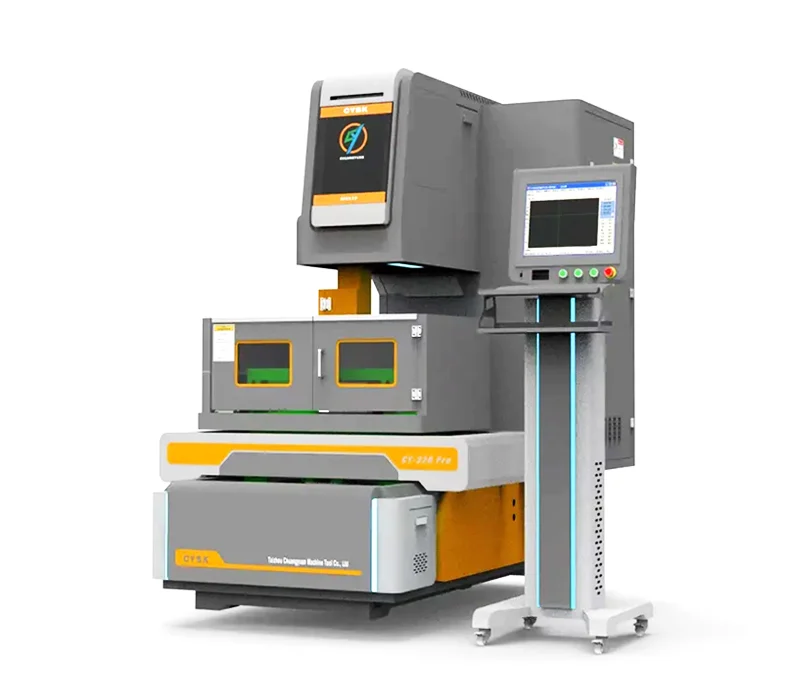
Eliminating Tooling Barriers in Small-Batch Production
In custom component manufacturing, traditional tooling often creates a cost-prohibitive entry barrier for low-volume orders. A wire cutting machine circumvents this entirely, offering a flexible approach that aligns perfectly with modern agile production needs.
No dedicated tooling required: zero setup delays and no tooling replenishment costs
Traditional processes like stamping or injection molding demand custom dies that can cost well over $10,000 and require weeks of lead time—costs difficult to justify for small batches of 50 to 500 units. A wire cutting machine eliminates the need for dedicated tooling entirely. It uses a continuously moving fine wire electrode to erode material under precise CNC control—no hard tool blanks, mold cavities, or wear-prone fixtures required. Setup is reduced to loading the program and clamping the workpiece, enabling operations to begin within minutes. This zero-tooling approach slashes initial capital outlay and compresses lead times by 30–50%, transforming how businesses test market demand or iterate prototypes. Without tool inventory constraints, production can scale up or down instantly to match real-time demand—no excess stock, no amortization pressure. Unlike progressive dies requiring frequent sharpening or replacement, the wire is consumed gradually and replaced automatically, eliminating unplanned maintenance interruptions. The result is a streamlined process where design-to-part cycles shrink from months to days.
CNC programmability enables rapid design iteration and part-specific customization
Once a CAD model is finalized, generating the CNC toolpath for wire EDM is a straightforward software-driven process. Engineers can modify geometries—widening a slot, adding a contour, or adjusting a profile—by simply editing the digital file. Updated G-code uploads in seconds, and a revised prototype can be cut within hours. This agility is invaluable for custom components with part-specific variations, such as orthopedic implants or aerospace brackets. Unlike processes locked in by costly tooling, wire cutting supports full customization without physical retooling. Iterative testing becomes seamless: multiple design variants can be produced, evaluated, and refined in a single afternoon. The same machine switches between jobs in seconds by loading a new program—enabling true mixed-model production for low-volume orders. With near-zero cost of change, manufacturers confidently offer bespoke services, and R&D teams accelerate validation cycles while exploring more innovative solutions. Ultimately, CNC programmability transforms the technology into a versatile tool that adapts to the design—not the other way around.
Achieving Micro-Precision with a Wire Cutting Machine
Tight-tolerance machining: ±0.0005" standard, ±0.0001" achievable on complex custom geometries
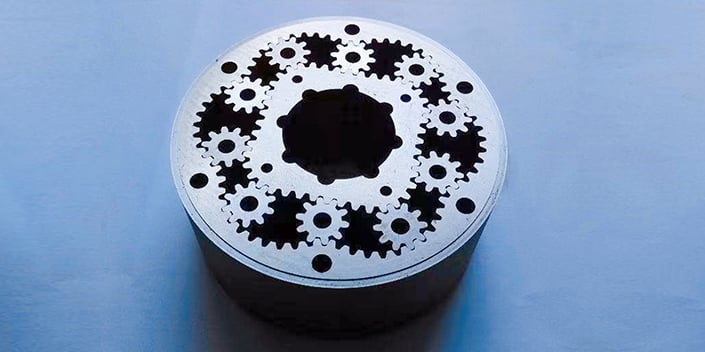
Wire electrical discharge machining (EDM), commonly referred to as a wire cutting machine, delivers repeatable accuracies that few other processes can match. In everyday production, a standard tolerance of ±0.0005 inch (0.0127 mm) is routine for contour cuts, profiles, and slots. When designs demand the utmost precision, modern wire cutting machines with ultra-fine wire electrodes reliably hold ±0.0001 inch (0.0025 mm)—a level that rivals femtosecond laser systems but without their limitations on material thickness or reflectivity. Where femtosecond lasers struggle with thick, reflective materials or certain alloys, wire EDM’s non-contact, electric-discharge approach cuts through hardened tool steels, titanium, and superalloys without sacrificing accuracy. True micro-scale precision comes from pairing CNC programmability with wires as thin as 0.0008 inch (0.02 mm). This capability empowers small-batch producers to iterate quickly on complex custom geometries—narrow slits, sharp internal corners, and fine-pitch gears—while maintaining the dimensional stability precision component customization demands.
| Cutting method | Typical tolerance (inch) | Typical tolerance (mm) |
|---|---|---|
| Wire EDM | ±0.0001 | ±0.0025 |
| Femtosecond laser | ±0.00004 | ±0.001 |
| Micro abrasive waterjet | ±0.0004 | ±0.01 |
| Laser | ±0.004 | ±0.1 |
| Plasma | ±0.002 | ±0.5 |
Superior surface finish control (Ra 0.4–1.6 µm) without secondary polishing
The spark-erosion process that delivers tight tolerances also governs surface texture—often eliminating the need for post-machining polishing. A wire cutting machine can directly produce finishes ranging from Ra 1.6 µm down to Ra 0.4 µm, depending on wire diameter, discharge energy, and flushing conditions. For example, a medium-power (6 kW) system with optimized spark settings routinely achieves Ra 0.4 µm on hardened steel—delivering a mirror-like surface that meets aerospace and medical component standards right off the machine. Because the wire never contacts the workpiece, there is no tool chatter, burnishing, or directional lay to correct. The resulting matte or semi-gloss finish remains uniform across intricate profiles, including thin walls and deep cavities that would be nearly impossible to polish manually. This built-in surface quality reduces manufacturing steps, preserves dimensional accuracy (no metal removal via abrasives), and ensures consistent aesthetics and functional performance—even for one-off, small-batch parts.
Handling Geometric Complexity Without Volume Compromise
Wire EDM cuts intricate 2D profiles, sharp internal corners, and deep slots without physical contact between the wire and workpiece. Because no cutting forces are generated, it holds ±0.005 mm tolerances on even the most fragile features. Unlike milling or turning—which often demand multiple setups and custom fixtures for each new geometry—a single CNC program guides the wire through the entire contour in one pass. That programmability slashes engineering lead time and eliminates tooling amortization thresholds: the per-part cost for a lot size of 1 remains comparable to a run of 100.
| Capability | Wire Cutting Machine | CNC Milling |
|---|---|---|
| Minimum batch size | 1 part (no dedicated tooling) | Typically 10+ to absorb fixture and tooling expense |
| Smallest internal corner radii | 0.1 mm | 0.5 mm or larger (limited by cutter diameter) |
| Setup time for a complex shape | Minutes (load program, align workpiece) | Hours (multiple fixtures, tool changes) |
| As‑cut surface finish (Ra) | 0.4–1.6 µm | Often requires secondary polishing for Ra <1.6 µm |
| Impact of part volume on cost | Nearly linear; no fixed tooling charge | Steep initial drop only after tooling is amortized |
This independence from volume economics lets engineers iterate rapidly and produce bespoke components without the overhead of hard tooling. As a result, the wire cutting machine turns geometric complexity into a standard, low-risk process—ideal for medical devices, aerospace brackets, and micro-electronics housings where every millimeter of shape must be exact and production quantities are small.
Gentle, Force-Free Machining for Delicate Custom Components
No mechanical stress or thermal distortion — ideal for thin-walled, heat-treated, or brittle alloy parts
A wire cutting machine utilizes electrical discharge machining (EDM), a non-contact process where sparks erode material without exerting mechanical force. This eliminates the risk of deformation in thin-walled components, heat-treated steels, and brittle alloys—parts that would crack or warp under traditional cutting loads. Unlike milling or turning, wire EDM generates no friction or cutting heat, so thermal distortion is entirely avoided. Parts retain their pre-machined hardness (even up to HRC60) and surface integrity. The method achieves dimensional tolerances as fine as ±0.0005 inches (0.0127 mm) and delivers sharp internal corners without residual stress. For delicate custom components in aerospace, medical devices, and micro-mold tooling, wire cutting enables complex geometries that conventional machining simply cannot replicate without compromising part quality.
FAQ
What is wire EDM or a wire cutting machine?
Wire EDM, or wire electrical discharge machining, is a non-contact machining process that uses a fine wire electrode to erode material under computer control, enabling precise material cutting without the need for physical contact.
What are the benefits of using wire cutting machines for small-batch production?
Wire cutting machines eliminate the need for costly and time-consuming tooling, offer rapid setup and CNC programmability for quick design iterations, and achieve high precision and surface quality. These benefits make them ideal for small-batch or custom component manufacturing.
What is the precision level of a wire cutting machine?
Wire EDM machines typically provide standard tolerances of ±0.0005 inches (0.0127 mm) and can achieve up to ±0.0001 inches (0.0025 mm) for complex geometries.
Are wire cutting machines suitable for delicate materials?
Yes, wire cutting machines are non-contact and produce no mechanical stress or thermal distortion. This makes them ideal for machining thin-walled, heat-treated, or brittle alloy parts.
Can wire cutting machines be used for small batches?
Absolutely. Wire EDM machines are highly efficient for low-volume production as they do not require dedicated tooling, making the per-part cost nearly linear regardless of batch size.