EN
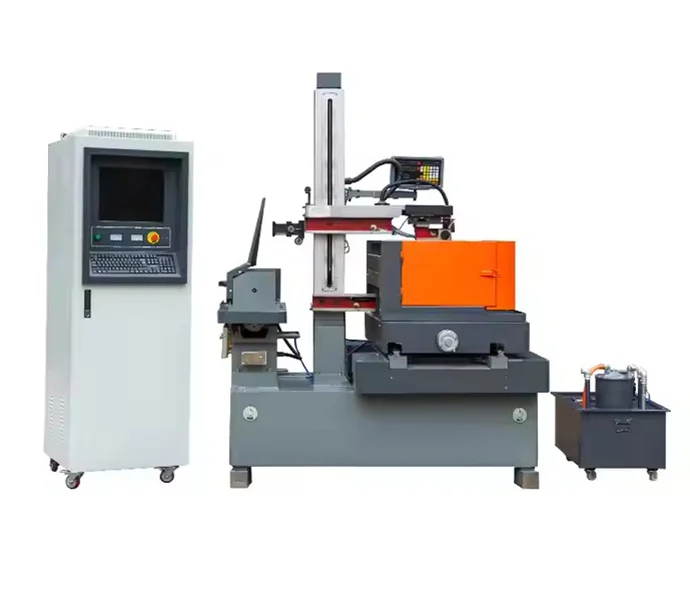
Optimize Core EDM Spark Erosion Machine Parameters for Energy Efficiency
Fine-tuning operational settings is the fastest, lowest-cost way to reduce energy use during spark erosion. An EDM spark erosion machine converts a significant share of input power into heat and electrode wear; minor adjustments to discharge behavior and idle-time management often yield 10–20% energy savings without altering existing hardware. The two most impactful levers are spark energy control and idle-power elimination.
Reduce Discharge Current and Pulse Duration While Maintaining Material Removal Rate
Spark energy is directly proportional to the product of discharge current and pulse-on time. Lowering either reduces thermal energy per spark—shrinking crater volume and material removed per pulse. To sustain the target material removal rate (MRR), operators can compensate by increasing spark frequency while using shorter, lower-current pulses. For instance, reducing peak current from 30 A to 20 A and pulse-on time from 100 µs to 60 µs cuts per-discharge energy by nearly 60%; doubling spark frequency can maintain MRR within 5–10% of baseline. This approach requires fast servo response and precise gap control, as more frequent, lower-energy discharges demand tighter spark-gap stability. Operators should incrementally reduce current and pulse width, validate MRR with a short test cut, and adjust off-time to preserve average current. In practice, shifting from roughing to semi-finish parameters—e.g., cutting peak current by 25%—often sustains acceptable productivity while trimming power consumption by 15–20%. Documenting each experiment (current, pulse width, frequency, measured MRR) enables consistent replication across jobs.
Fine-Tune Spark Gap and Duty Cycle to Eliminate Idle Power Waste
Idle time between discharges is a hidden energy drain—even when no spark forms, the power supply, servo motors, and dielectric pump draw base load. Minimizing non-productive time in the duty cycle (pulse-on time ÷ total cycle time) directly lowers total kWh per part. A wider spark gap increases required off-time for debris ejection, but excessive gap also raises dielectric flow demand and dwell time. Maintaining the smallest stable gap—typically 10–50 µm depending on electrode size—reduces off-time and raises effective duty cycle without arcing risk. Well-controlled gaps support duty cycles of 80–90% during roughing and 60–70% during finishing, versus energy-wasting defaults near 50%. Adaptive gap control systems, linked to real-time voltage feedback, dynamically hold the minimum viable gap—reducing dielectric pumping energy and compressing the spark train. On a 20-A sinker machine, moving from 50% to 75% duty cycle can cut idle power consumption by roughly one-third, with no change in actual spark erosion time. Pair this with a targeted dwell-reduction strategy: monitor spent-flushing condition, apply jump flushing only when debris accumulation is observed, and avoid over-flushing that demands excess pump energy. These small, consistent refinements deliver measurable energy savings without tooling changes.
Upgrade EDM Spark Erosion Machine Subsystems with Energy-Saving Technology
Modernizing auxiliary systems offers one of the fastest paths to reducing total energy consumption on an EDM spark erosion machine. While parameter optimization targets the spark gap, subsystem upgrades address parasitic losses that occur 100% of the time the machine is powered on.
IoT-Enabled Smart Cooling Systems with Adaptive Dielectric Flow Control
Standard EDM machines often run dielectric chillers and pumps at fixed speed—regardless of actual thermal load. An IoT-enabled smart cooling system transforms this constant drain into an on-demand process. Thermal sensors in the dielectric reservoir, at the spark gap, and on the generator’s heat sinks feed real-time data to a controller, which adjusts chiller compressor speed and dielectric pump flow to match precise cooling needs. During high-amperage roughing, flow and cooling ramp up; during low-stress finishing, they scale back significantly. This eliminates energy waste from overcooling. Manufacturers integrating such systems report up to 30% reduction in cooling-related energy use—lowering overall EDM consumption without affecting part quality.
High-Efficiency CNC Power Supplies and Regenerative Energy Recovery in Servo Axes
Electrical conversion from grid power to high-frequency spark pulses is inherently lossy in older machines. Retrofitting a modern, high-efficiency CNC power supply based on silicon carbide (SiC) semiconductors drastically reduces thermal losses: SiC units achieve up to 96% conversion efficiency, compared to 85–90% for legacy silicon-based supplies—meaning more input power becomes usable spark energy. A second major source of waste lies in the servo system. In conventional drives, kinetic energy from decelerating high-speed electrode jumps is dissipated as heat through braking resistors. A regenerative energy recovery module captures this energy, converts it back to electricity, and feeds it onto the machine’s internal DC bus—powering the next acceleration or position hold. This prevents full energy loss during rapid axis motion, measurably reducing net servo power draw during jump-intensive operations.
Choose Electrode and Dielectric Materials That Lower Total EDM Spark Erosion Machine Energy Demand
Material selection directly impacts the energy profile of an EDM spark erosion machine. While dielectric fluids influence flushing and insulation, electrode material governs heat conduction, wear resistance, and erosion dynamics—ultimately dictating power consumption per unit of material removed.
Copper-Tungsten vs. Graphite Electrodes: Energy per mm³ Removed Compared
Graphite electrodes typically deliver lower energy per cubic millimeter removed in roughing cuts due to their high thermal resistance, which supports elevated peak currents with minimal wear. Their self-lubricating microstructure also reduces burn risk and secondary rework. Copper-tungsten, by contrast, excels in high-precision finishing: its exceptional erosion resistance preserves tight tolerances over long runs, eliminating re-machining of worn electrode shapes. By avoiding redundant spark-erosion passes, Cu-W can cut total job energy—even if its per-pulse energy is higher. The most energy-efficient strategy matches material properties to the machining phase: graphite for bulk stock removal, copper-tungsten for final cavities—ensuring generator power translates directly into finished part volume, not wasted thermal stress or electrode consumption.
Monitor and Model Real-Time Energy Use Across the EDM Spark Erosion Machine Workflow
Incorporating real-time energy monitoring into the EDM workflow enables manufacturers to pinpoint exact energy drains during every phase—roughing, finishing, and flushing. Installing power meters at the machine level delivers granular data revealing inefficiencies such as prolonged idle times or suboptimal pulse settings. This data feeds a lightweight machine-learning model trained on each job’s energy signature. The model then recommends parameter adjustments—like reducing pulse duration or modulating dielectric flow—that preserve part quality. Field deployments of such IoT retrofit projects have demonstrated measurable reductions in kWh per part after implementing adaptive control driven by streaming energy data. Real-time dashboards also support internal carbon-reduction targets and simplify sustainability reporting. Ultimately, this data-driven loop transforms energy management from a periodic audit into a permanent, self-optimizing process—lowering operational costs and extending the life of critical components.
FAQ
How can lowering discharge current and pulse duration save energy?
Lowering discharge current and pulse duration reduces the thermal energy per spark, leading to a smaller crater volume and energy consumption per pulse, while still maintaining material removal rates with increased spark frequency.
What is the role of spark gap adjustment in energy efficiency?
Maintaining an optimized spark gap minimizes resting idle times and enhances the duty cycle, which directly reduces idle power consumption and overall energy usage.
What is the advantage of IoT-enabled smart cooling systems?
IoT-enabled smart cooling systems adjust flow and cooling based on real-time machine requirements, significantly reducing energy wastage and increasing overall efficiency.
Why should I consider upgrading to high-efficiency power supplies for my EDM machine?
Upgrading to silicon carbide-based high-efficiency CNC power supplies improves energy conversion efficiency and reduces thermal losses compared to older systems.
How does real-time energy monitoring improve EDM efficiency?
Real-time energy monitoring identifies inefficiencies during operation. Machine-learning models based on energy data can recommend optimization strategies, enhancing energy savings without sacrificing part quality.
Table of Contents
- Optimize Core EDM Spark Erosion Machine Parameters for Energy Efficiency
- Upgrade EDM Spark Erosion Machine Subsystems with Energy-Saving Technology
- Choose Electrode and Dielectric Materials That Lower Total EDM Spark Erosion Machine Energy Demand
- Monitor and Model Real-Time Energy Use Across the EDM Spark Erosion Machine Workflow
- FAQ