EN
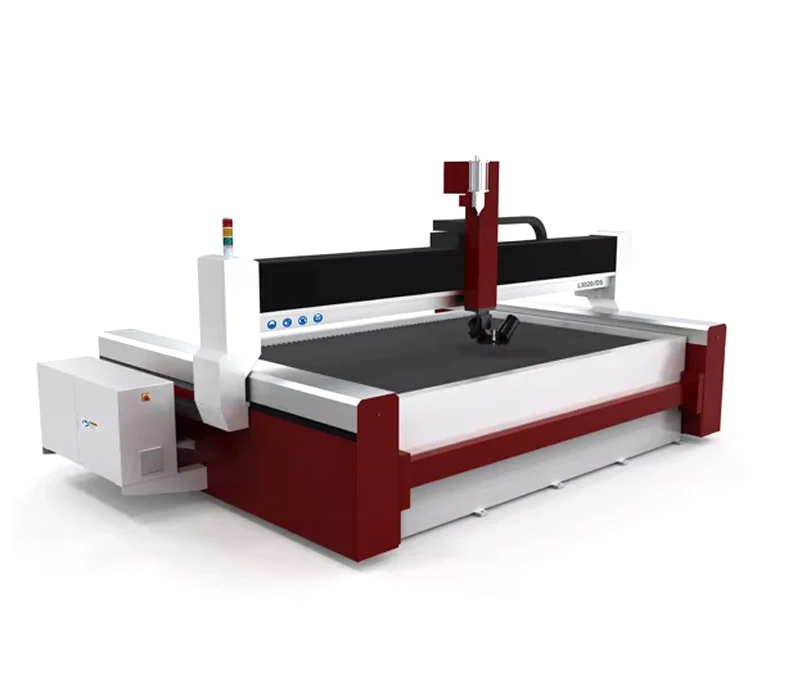
True Non-Planar Contouring: How 5-Axis Waterjet Cutting Machine Masters Complex 3D Curves
Helical, conical, and beveled curves — single-setup contouring without repositioning
A five-axis waterjet cutting machine goes beyond vertical profiling by integrating a tilting head (A-axis) and rotational axis (C-axis), enabling the nozzle to dynamically orient itself for helical spirals, conical tapers, and precision bevels—all from a single fixture. Unlike three-axis systems requiring manual repositioning or multiple setups, this configuration eliminates stack-up errors inherent in multi-step machining. A beveled edge for weld preparation, for example, can be cut in the same pass as the primary profile—replacing secondary grinding with a clean, draft-free geometry that matches the CAD model. Helical forms like auger flights or conical seats are produced in one continuous motion, significantly reducing cycle time. Taper control is built-in: the machine continuously adjusts nozzle tilt to compensate for jet deflection, preserving uniform kerf width across varying material thicknesses and curvatures. This single-setup capability forms the technical foundation for true non-planar contouring.
Aerospace case study: Turbine blades and organic freeform surfaces with ±0.05 mm edge fidelity
In aerospace manufacturing—where turbine blades, impellers, and structural brackets demand uncompromising accuracy—five-axis waterjet systems routinely achieve edge fidelity within ±0.05 mm. When processing nickel-based superalloys into airfoil shapes, the machine follows native 3D CAD spline geometry at precisely calculated tilt angles, preserving aerodynamic intent without heat-affected zones. Real-time kerf compensation algorithms adjust feed rate and nozzle orientation to account for jet lag and material variation, delivering smooth, ready-for-assembly surfaces. Because the cold-cutting process avoids microstructural changes, part integrity remains intact—even on thick sections. Achieving this level of precision across large, organic geometries relies on high-resolution height sensing and closed-loop motion control, features standard in modern five-axis platforms. As a result, waterjet has become a competitive alternative to EDM for many aerospace applications where thermal distortion, tool wear, or secondary finishing would otherwise compromise performance.
Precision Beveling & Multi-Angle Features in One Pass
Eliminating secondary operations: Time and cost savings on chamfers, countersinks, and tapered edges
Five-axis waterjet cutting consolidates angled features—chamfers, countersinks, and weld-prep bevels—into the primary cutting cycle, eliminating separate setups, fixtures, and manual edge preparation. By tilting the abrasive jet up to ±45° while interpolating motion, the system produces Y-, X-, or K-bevels, tapered countersinks, and compound chamfers in a single pass. This integration cuts per-part processing time by 50–70% in heavy-plate applications. A pressure-vessel manufacturer, for instance, reduced total weld-prep cost by 40% after adopting single-pass bevel cutting. Fewer handling steps also lower misalignment risk and rework rates, while freeing skilled operators for higher-value tasks. Edge geometries are held to ±0.1 mm repeatability—delivering leaner workflows, faster throughput, and consistent quality without sacrificing precision.
Dynamic nozzle tilting with real-time kerf compensation for consistent edge geometry
Consistent bevel geometry on complex paths demands more than static tilt—it requires dynamic, sensor-informed adjustment. Advanced five-axis waterjet systems use real-time kerf compensation to modulate A- and C-axis angles and traverse speed based on the instantaneous cutting vector. Leveraging either integrated sensors or CAM-driven models, the control system anticipates jet lag and taper effects, automatically correcting nozzle orientation to maintain square faces—or deliver exact bevel angles—along curved or variable-thickness edges. This is especially critical on materials up to 150 mm thick, where jet deflection varies with speed, direction, and composition. The outcome is uniform land width, precise root opening, and repeatable edge geometry across every contour—from a 30° pipe saddle bevel to a 5° turbine flange taper. With no manual intervention required, first-pass yield exceeds 98%, and the same system delivers tight-tolerance results across aluminium, stainless steel, titanium, and other high-performance alloys.
Seamless CAD-to-Cut Workflow for Non-Planar Geometry
CAM-driven 5-axis toolpath generation from native 3D CAD (not STL) — preserving design intent
True non-planar contouring begins with accurate digital translation. Five-axis waterjet systems import native 3D CAD formats—such as STEP or IGES—directly into CAM software, bypassing the geometric approximations of STL files. The CAM engine reads exact surface definitions, including compound curves and organic freeforms, then generates continuous five-axis toolpaths with full kinematic control. Bevel angles, curvature continuity, and feature relationships remain mathematically intact, ensuring the physical part reflects design intent without manual data repair. Sophisticated postprocessors convert these paths into synchronized machine code, coordinating X, Y, Z, A, and C axes for smooth, gouge-free motion. The result is a seamless digital thread—from 3D design to finished part—that reduces programming time, prevents geometry shifts, and preserves fidelity across even the most demanding non-planar geometries.
Maintaining Optimal Nozzle Standoff Across Compound Curvatures
Active height sensing + adaptive Z-axis modulation for consistent jet focus and taper control
Maintaining optimal nozzle standoff—typically 1–3 mm—is essential for consistent jet focus, power delivery, and taper control across compound 3D surfaces. Five-axis waterjet machines use capacitive or laser-based active height sensing to measure the local gap in real time; the control system responds instantly by modulating the Z-axis. This closed-loop adaptation ensures uniform cutting energy and minimal taper, even over rapidly changing contours or warped stock. The result is high-quality, repeatable cuts without manual intervention—enabling reliable production of complex, non-planar parts while preserving edge definition and dimensional accuracy.
FAQs
What is true non-planar contouring in 5-axis waterjet cutting?
True non-planar contouring refers to the ability of 5-axis waterjet cutting machines to dynamically adapt nozzle orientation, enabling the cutting of complex 3D geometries such as helical spirals, conical tapers, and precision bevels in a single setup.
Can a 5-axis waterjet machine handle aerospace applications?
Yes, 5-axis waterjet machines excel in aerospace applications, achieving edge fidelity within ±0.05 mm and processing challenging geometries like turbine blades and impellers while preserving material integrity.
How does real-time kerf compensation benefit 5-axis waterjet cutting?
Real-time kerf compensation ensures consistent edge geometry by dynamically adjusting nozzle orientation and feed rate based on the cutting vector. This is essential for maintaining precision, especially in thick or curved materials.
What materials can a 5-axis waterjet machine cut?
5-axis waterjet machines can cut a wide range of materials, including aluminum, stainless steel, titanium, nickel-based superalloys, and other high-performance alloys.
How does active height sensing contribute to cutting precision?
Active height sensing uses real-time measurements to maintain optimal nozzle standoff, ensuring consistent jet focus and taper control across complex 3D surfaces, improving both accuracy and cut quality.
Table of Contents
- True Non-Planar Contouring: How 5-Axis Waterjet Cutting Machine Masters Complex 3D Curves
- Precision Beveling & Multi-Angle Features in One Pass
- Seamless CAD-to-Cut Workflow for Non-Planar Geometry
- Maintaining Optimal Nozzle Standoff Across Compound Curvatures
-
FAQs
- What is true non-planar contouring in 5-axis waterjet cutting?
- Can a 5-axis waterjet machine handle aerospace applications?
- How does real-time kerf compensation benefit 5-axis waterjet cutting?
- What materials can a 5-axis waterjet machine cut?
- How does active height sensing contribute to cutting precision?