EN

Aerospace Maintenance: On-Wing EDM Drilling for Turbine Cooling Holes
Thermal Management Challenge: Micro-cooling holes in Inconel and titanium turbine vanes
Modern jet engines operate with turbine inlet temperatures exceeding the melting point of nickel-based superalloys. Without precise micro-cooling, blades and vanes would fail within seconds. The solution lies in thousands of tiny, often diffuser-shaped air passages that create a protective film over the metal surface. Drilling these features into Inconel and titanium demands extreme accuracy—holes commonly range from 0.012 to 0.030 inches in diameter. Conventional twist drills immediately work-harden these alloys, causing rapid tool wear and inconsistent geometry. Shaped cooling holes add further complexity, as manufacturers seek contours that optimize airflow and reduce fuel consumption. On-wing maintenance compounds the difficulty: part removal requires full engine teardown, extended downtime, and high cost. A reliable, low-stress drilling method is therefore critical.
Portable EDM Drilling Advantage: Zero thermal distortion, burr-free 0.012″–0.030″ holes without part removal
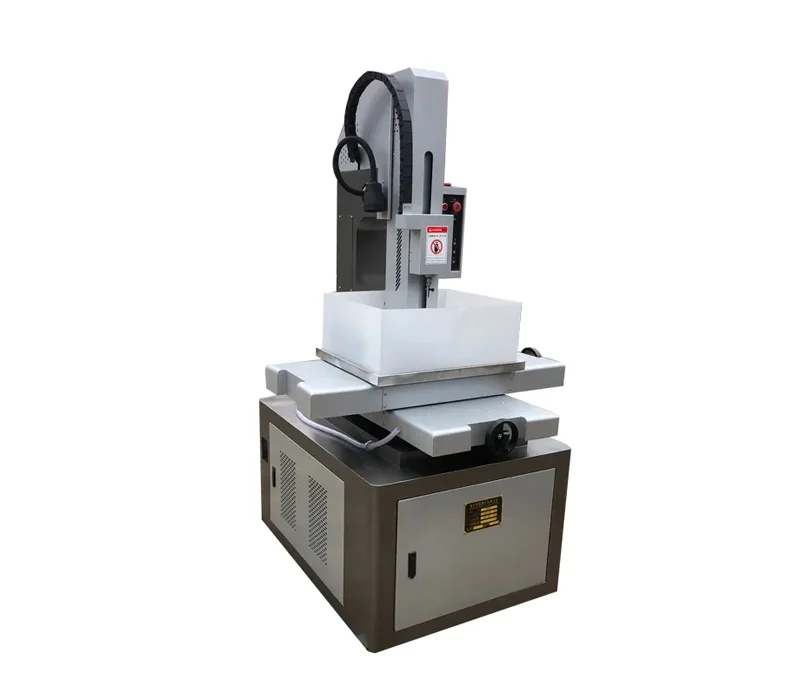
A portable EDM drilling machine overcomes these barriers by using spark erosion to vaporize material without physical contact. With no cutting force, it easily handles hardened Inconel and titanium while avoiding heat-affected zones (HAZ) entirely. The result is a burr-free hole with smooth sidewalls—eliminating secondary deburring—and zero mechanical stress on the component, preserving its fatigue life. Technicians bring the unit directly to the wing, clamp it over the blade or vane, and drill multiple cooling holes in situ—no disassembly required. Hole diameters from 0.012″ to 0.030″ are produced in seconds, with repeatable tolerances and no thermal distortion. This capability drastically cuts turnaround time and maintains the factory heat treatment, making portable EDM drilling the preferred method for modern turbine maintenance.
Medical Device Manufacturing: Burr-Free Micro-Drilling in Implant Alloys
Critical Requirement: Sub-0.004″ precision holes in Ti-6Al-4V and cobalt-chrome for osseointegration and fluid channels
The performance of modern medical implants hinges on microscopic features invisible to the naked eye. For osseointegration surfaces on dental implants and orthopedic devices, a network of precise pores enables bone cells to grow into the implant, forming a stable biological bond. Similarly, intricate fluid channels in drug-delivery pumps and surgical instruments demand absolute dimensional fidelity. These critical holes—often below 0.004 inches in diameter—must be produced in biocompatible alloys like Ti-6Al-4V and cobalt-chrome. While chosen for strength and corrosion resistance, these materials rapidly wear or break conventional micro-drills. More critically, any burr, micro-crack, or edge tear creates a site for bacterial colonization and can trigger post-surgical complications—including infection, inflammation, and implant rejection. Mechanical machining also introduces subsurface stress that compromises metallurgical integrity, creating undetectable failure points in the body. A non-contact, stress-free process aligned with clean-room protocols—and eliminating manual deburring—is therefore essential.
Why Portable EDM Drilling Machine Excels: No mechanical stress, no heat-affected zone (HAZ), full compliance with ISO 13485
Portable EDM drilling solves these challenges at the process level: thermal erosion replaces mechanical force. Rapidly pulsed electrical discharges vaporize material atom by atom, with the rotating electrode never contacting the workpiece. This eliminates mechanical stress, micro-cracking, and burr formation—delivering a pristine, biocompatible surface straight off the machine. Crucially, material removal occurs within a localized, dielectric-cooled spark zone, preventing HAZ formation and preserving the alloy’s certified microstructure. That ensures retained fatigue resistance and long-term stability—vital for load-bearing devices like hip stems and spinal cages. High repeatability and integrated process monitoring align naturally with ISO 13485 documentation and validation requirements. By integrating portable EDM directly onto the production floor with non-contaminating coolant systems, manufacturers achieve a fully validated, end-to-end drilling process—free of manual post-processing—safeguarding patient safety and regulatory compliance.
Mold & Die Field Repair: Eliminating Downtime with On-Machine EDM Drilling
Production Impact: $50K/hour downtime cost in high-mix injection molding—portable EDM drilling enables same-shift cavity repair
Unplanned stoppages in injection molding can exceed $50,000 per hour, according to a 2023 industry analysis. When a cavity develops cracks or wear, traditional repair requires removing the multi-ton mold, shipping it to a toolroom, and waiting days. A portable EDM drilling machine changes that equation. It brings precision hole-making directly to the press—bypassing disassembly and transport. Maintenance teams can drill start holes for wire EDM or create venting channels in hardened steel cavities within the same shift. The process restores function without disturbing alignment or thermal equilibrium, slashing mean time to repair from weeks to hours. This mobility eliminates the need for costly spare mold inventories, freeing capital and floor space. For high-mix, low-volume producers, on-demand repair preserves delivery schedules and prevents cascading production delays.
Technical Fit: Direct start-hole drilling in hardened A2, D2, and H13 tool steels—no disassembly or heat treatment reversal needed
Mold steels like A2, D2, and H13 gain their wear resistance through hardening to 50–62 HRC—making conventional drilling impractical. Portable EDM drilling sidesteps mechanical cutting entirely, eroding material with controlled sparks to produce start holes for wire threading or small fluid channels—without inducing stress or softening the heat-treated zone. The process requires no pre-heating, no post-drilling re-hardening, and no disassembly of the mold assembly. A technician can position the portable head, set coordinates, and drill a 0.020-inch pilot hole in minutes. The result is a clean, burr-free hole with zero thermal distortion—preserving the die’s metallurgical integrity. This on-machine capability eliminates handling-related distortion risk and ensures repairs meet original tolerances, keeping molds in production and extending service life.
Energy Sector Field Service: Deep-Hole EDM Drilling in Confined Nuclear and Turbine Environments
Maintaining power generation assets in confined spaces—whether a nuclear reactor vessel or a steam turbine casing—demands hole-making processes that leave no margin for error. A portable EDM drilling machine meets this challenge by producing deep, high-aspect-ratio holes directly on site, eliminating the need to cut out and transport massive components. Conventional mechanical drilling cannot reliably achieve depth-to-diameter ratios exceeding 100:1 in hardened superalloys, but EDM drilling routinely reaches 300:1 in Inconel 718, titanium, and martensitic stainless steels—without inducing micro-cracks or work hardening. The non-contact electrical discharge process generates virtually no heat-affected zone, preserving structural integrity—a non-negotiable requirement when working on primary pressure boundaries or rotating turbomachinery.
On-site EDM drilling also removes the long lead times and safety risks associated with component removal. In nuclear service, even a single unplanned outage can incur substantial generation losses; the ability to add new instrumentation ports, modify cooling channels, or repair plugged bolt holes while the vessel remains in place is a decisive operational advantage. Turbine field-service teams rely on portable EDM drilling to restore tip clearances, open cooling air passages in blade roots, and create precise injection holes in fuel nozzles—all without disturbing rotor balance. The process yields burr-free holes with surface finishes better than 32 μin Ra, meeting the exacting standards of industry codes and ensuring reliable, long-term performance in the most hazardous environments.
FAQ
What is EDM drilling?
EDM (Electrical Discharge Machining) drilling uses electrical sparks to erode material, producing highly precise and burr-free holes without mechanical cutting.
How does portable EDM drilling benefit aerospace maintenance?
Portable EDM drilling allows technicians to create precise cooling holes directly on turbine blades and vanes without part removal, reducing downtime and maintaining factory heat treatment.
Can portable EDM drilling produce burr-free micro-holes?
Yes, it delivers burr-free, high-precision holes ideal for medical implants and critical components, ensuring compliance with regulatory standards.
How does portable EDM drilling accelerate mold and die repair?
It enables on-machine repairs of molds and dies without disassembly, reducing downtime and preserving workpiece integrity.
Is EDM drilling effective for confined environments like nuclear reactors?
Yes, portable EDM drilling can create deep holes in confined spaces, maintaining structural integrity while avoiding removal and transport of heavy components.
Table of Contents
- Aerospace Maintenance: On-Wing EDM Drilling for Turbine Cooling Holes
- Medical Device Manufacturing: Burr-Free Micro-Drilling in Implant Alloys
- Mold & Die Field Repair: Eliminating Downtime with On-Machine EDM Drilling
- Energy Sector Field Service: Deep-Hole EDM Drilling in Confined Nuclear and Turbine Environments
- FAQ