EN
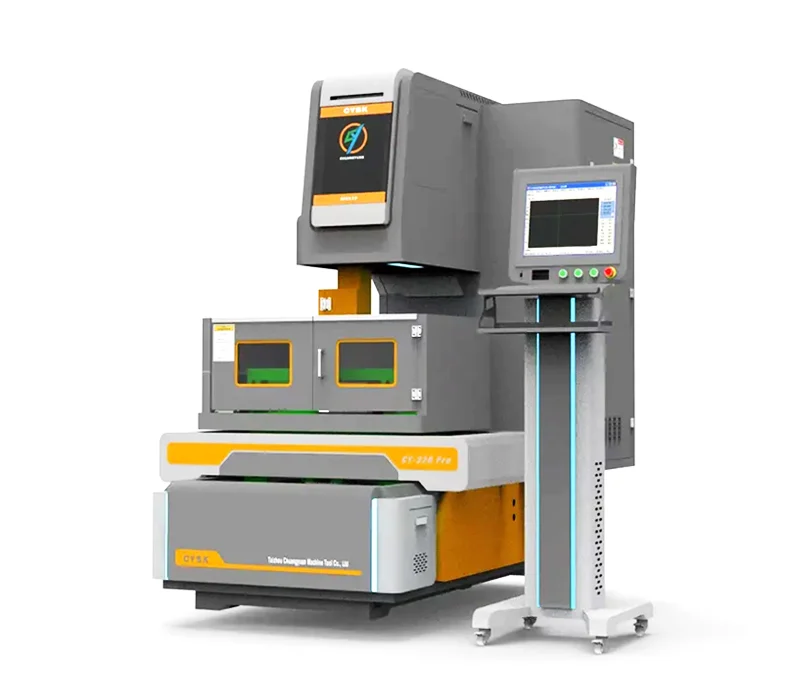
Core Technical Specifications That Define EDM Machine Performance
Dielectric Fluid System Design and Flushing Efficiency for Stable Burn Control
The dielectric fluid system is the circulatory backbone of any EDM machine—providing electrical insulation, cooling, and debris evacuation. Efficient flushing preserves spark gap stability, which is essential for consistent material removal and dimensional accuracy. Without it, erratic discharges, short circuits, and recast layer buildup rapidly degrade surface integrity and precision. High-pressure flow—delivered either through the electrode (sinker) or around the wire (wire EDM)—combined with sub-micron filtration and precise thermal regulation, prevents debris re-adhesion and maintains uniform dielectric strength. In wire EDM, deionized water is standard; sinker EDM typically uses high-flash-point hydrocarbon oils, both requiring tight temperature control to avoid thermal drift. Smart systems now feature adaptive flushing, modulating pressure and flow in real time based on gap voltage feedback—enabling stable machining even in deep cavities or narrow slots. As noted in Nature (2025), flushing conditions rank among the most influential variables affecting material removal rate and surface quality.
Electrode Compatibility, Axis Precision, and Travel Range for Complex Geometry Machining
Machining intricate geometries demands synergy between electrode selection, multi-axis positioning accuracy, and mechanical travel envelope. Copper, graphite, and copper-tungsten electrodes each offer distinct trade-offs in wear resistance, conductivity, and compatibility with workpiece alloys—optimal pairing minimizes electrode wear ratio (EWR) while preserving fine features. Positioning repeatability routinely reaches ±0.005 mm, supported by thermally compensated linear scales that maintain tolerance stability across production runs. Travel ranges commonly span 800 × 600 mm, though larger machines accommodate oversized molds and aerospace components. Rigid frame construction and vibration-damping design are critical for achieving sub-0.2 µm surface finishes. Equally important is synchronization between axis motion and power supply output: stable discharge pulses must align precisely with programmed spindle speed and orbiting routines. Together, these capabilities determine whether the machine can reliably produce complex shapes—without sacrificing speed, accuracy, or surface integrity.
Measured Output Quality: Precision, Surface Finish, and Material-Specific Capabilities
Achieving Sub-0.2 µm Ra Surface Finish and Minimizing Recast Layer Depth
Surface finish in EDM is quantified as Ra (Roughness Average), with mission-critical applications—such as sealing surfaces or medical implants—requiring sub-0.2 µm. Advanced wire-EDM systems achieve finishes below 0.1 µm Ra using high-frequency pulse generation and optimized dielectric flushing to stabilize the spark gap. The recast layer—the resolidified, metallurgically altered zone left on the machined surface—directly impacts fatigue life and corrosion resistance. Controlled low-energy discharges, combined with multi-skim finishing strategies, reduce recast depth to under 2 µm while eliminating micro-cracks. Uniform debris evacuation—via coaxial, submerged jet, or oscillating flushing—is essential to prevent secondary discharges that compromise surface consistency. Real-time gap-voltage monitoring enables adaptive response across complex contours, delivering repeatable Ra values and minimal recast—particularly valuable when downstream polishing or coating is required.
Machining Hard, Brittle, or Exotic Alloys: Deformation Resistance and Electrode Wear Rates
EDM excels where conventional machining fails: nickel-based superalloys, tungsten carbide, polycrystalline diamond (PCD), and titanium aluminides. Because material removal occurs via thermal erosion—not mechanical force—it preserves thin-walled features and brittle structures without distortion. Electrode wear remains the primary cost driver: graphite-to-steel EWRs can fall below 0.1%, but misconfigured parameters on exotic alloys may push wear above 15%. Adaptive control systems—adjusting pulse duration, polarity, and current based on real-time workpiece resistivity—maintain EWRs below 5% for titanium aluminides (Journal of Manufacturing Processes, 2023). High-rigidity frames and active thermal compensation ensure positional accuracy within ±2 µm over extended production cycles. When paired with low-wear orbiting routines and matched dielectric oils, these systems deliver predictable cavity profiles in hardened tool steels and ceramics—keeping per-part electrode consumption stable and process economics transparent.
Total Cost of Ownership and Scalability for Industrial EDM Machine Investment
Balancing Upfront Budget with CNC Integration, Automation Readiness, and Tooling ROI
Evaluating an EDM machine solely on purchase price overlooks the majority of long-term costs. Industry data shows acquisition accounts for just 20–40% of total lifecycle spend. True TCO includes CNC integration—compatibility with existing CAD/CAM platforms, post-processors, and controller upgrades—as well as automation readiness for unattended operation. Tooling ROI is equally decisive: wire consumption, electrode wear rates, and dielectric filtration costs directly impact per-part economics. A lower-cost machine with proprietary, high-margin consumables can erode margins over its 10–15-year service life. Conversely, investments in energy-efficient servo drives, robust filtration, and native automation interfaces often yield rapid operational savings. Buyers should model a 5-year TCO covering installation, training, maintenance contracts, spare parts, downtime risk, and energy use. The table below summarizes key cost categories to support objective vendor comparison:
| Cost Category | Typical TCO Share | Key Considerations for EDM |
|---|---|---|
| Purchase & commissioning | 25–35% | CNC control type, software licenses |
| Tooling & consumables | 20–30% | Electrode materials, wire consumption, filters |
| Energy & utilities | 10–15% | Spark generator efficiency, chiller power |
| Maintenance & repairs | 15–20% | Service contracts, spare parts availability |
| Downtime & training | 5–10% | Machine reliability, operator skill level |
| Automation integration | 5–10% | Robot interface, pallet changers, remote monitoring |
This framework ensures capital decisions align not only with technical fit—but with long-term scalability, uptime, and profitability.
Vendor Evaluation: Support, Service Network, and Application Engineering for EDM Machine Buyers
A rigorous evaluation of the vendor ecosystem is as critical as the machine’s technical specifications. Even the most advanced EDM platform becomes a bottleneck without responsive application engineering and field support. During pre-sale engagement, verify whether the vendor offers hands-on process validation: test cuts on your actual workpiece materials, electrode strategy optimization for specific features, and empirical verification of achievable surface finish and geometric tolerances—before signing a purchase order. This upfront collaboration shortens internal ramp-up time and confirms the machine will deliver promised performance for your part family.
Post-purchase, uptime hinges on service depth and responsiveness. Confirm guaranteed on-site response times, regional availability of certified field technicians, and whether remote diagnostics are standard—not optional—to minimize travel delays. Equally vital is the consumables and spares supply chain: DI resin, filters, power contacts, and wire guides must be available with predictable lead times. Request documentation of critical spares held at local hubs—and ask how emergency orders for legacy models are handled. Vendor flexibility in production planning—including capacity for rush jobs or overflow machining—adds tangible resilience to your operations.
Finally, assess quality culture through verifiable evidence: ISO 9001 or AS9100 certification, documented inspection protocols for new and rebuilt machines, and willingness to share first-article inspection reports from comparable applications. Most telling is access to reference customers—especially those willing to discuss repeatability, service responsiveness, and real-world uptime. That transparency moves the decision beyond marketing claims and into measurable, operational confidence.
FAQ
Why is dielectric fluid system design critical in EDM machines?
The dielectric fluid system ensures electrical insulation, cooling, and debris evacuation, which are crucial for spark gap stability and consistent material removal. Efficient flushing prevents issues like recast layer buildup and surface inaccuracies.
What are the important factors in electrode selection?
Electrode selection depends on material wear resistance, conductivity, and compatibility with workpiece alloys. Proper matching minimizes electrode wear while achieving fine-feature precision.
How does EDM handle hard or brittle materials?
EDM uses thermal erosion instead of mechanical force, which helps preserve the integrity of thin or brittle materials. It is effective for machining superalloys, tungsten carbide, and ceramics.
What is Total Cost of Ownership (TCO) for EDM machines?
TCO includes all lifetime costs of the machine, such as purchase price, maintenance, energy usage, and consumables management. It helps buyers evaluate long-term investment benefits.
How can vendors be evaluated effectively for EDM machine purchases?
Evaluate vendors based on their support services, consumables supply chain, regional technician availability, and hands-on process validation to verify machine performance before purchase.
Table of Contents
- Core Technical Specifications That Define EDM Machine Performance
- Measured Output Quality: Precision, Surface Finish, and Material-Specific Capabilities
- Total Cost of Ownership and Scalability for Industrial EDM Machine Investment
- Vendor Evaluation: Support, Service Network, and Application Engineering for EDM Machine Buyers
- FAQ