EN

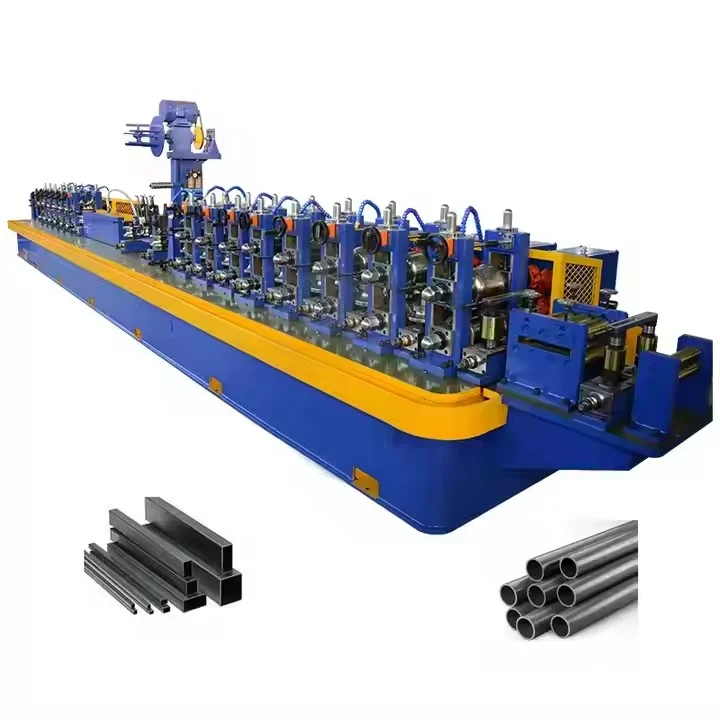
Boosting Productivity and Operational Efficiency with Automatic Tube Mill Units
Modern manufacturing factories invest in automatic tube mill units because they convert coiled strip into finished tube at speeds manual lines cannot match. The gains appear in cycle time, uptime, and labor-independent output.
How automated tube mill units cut cycle time by 35–50% versus manual setups
In manual tube mill operations, operators stop frequently to reposition coil, adjust roll gaps, and measure cut lengths. Automatic tube mill units eliminate these stops with servo-driven coil feeding, programmable roll stands, and synchronized flying cutoffs. Industry performance comparisons show automatic lines running at up to 120 meters per minute—versus 20–40 meters per minute for manual lines—reducing full-part cycle time by 35–50%, even after accounting for setup and inspection. Higher overall equipment effectiveness reinforces the gain: automatic systems routinely achieve 80–92% OEE, compared with 50–65% for manual operations. Dual coil accumulators enable continuous welding during coil changes, while recipe-based weld control removes micro-stops caused by operator error. Consistent execution also reduces rework, so throughput gains aren’t eroded by quality sorting or repair.
Real-world impact: Eliminating labor-dependent bottlenecks in high-volume automotive tubing production
High-volume automotive tubing production cannot tolerate shift-to-shift variation. Manual lines rely on skilled operators for alignment, weld parameter adjustments, and quality checks—introducing variability due to fatigue, turnover, and inconsistent decisions. Automatic tube mill units replace these labor-dependent bottlenecks with validated, recipe-driven control, ensuring identical parameters across shifts. In a 2024 industry benchmark, a single automatic line operating at 120 meters per minute and 90% OEE produced over 130,000 meters of tube in a 20-hour day—supporting just-in-time automotive supply chains where a line stoppage can cascade into vehicle assembly delays. Removing manual intervention at welding and cutting steps also cuts changeover-related downtime. Operators shift from repetitive handling to supervision and exception response, further stabilizing output.
Ensuring Precision and Consistency Through Automated Tube Mill Quality Control
Meeting OEM tolerances: Why ±0.15 mm wall thickness variance triggers batch rejection
For high-volume tube production, wall thickness is a make-or-break dimension. Many original equipment manufacturers (OEMs) and tier-one buyers now enforce a hard acceptance window of ±0.15 mm around nominal wall thickness. A single coil exceeding that limit can trigger full batch rejection. Automatic tube mill quality control systems enforce this tolerance using laser or ultrasonic wall-thickness measurement at multiple points along the forming line. Feedback loops compare live readings to the target profile and flag nonconforming sections before they enter downstream cutting or bundling—preventing small deviations from accumulating into large scrap events. This in-line verification helps manufacturers avoid costly chargebacks, line stoppages, and re-qualification audits. Wall-thickness variation remains the leading cause of rejected structural and automotive tube lots, making real-time verification a critical investment for tolerance-sensitive customers.
Real-time micron-level roll gap adjustment and its role in reducing out-of-spec output by up to 92%
Real-time roll gap control operates at the micron level, adjusting forming and sizing stands while the tube mill runs. Each stand’s position is monitored by linear encoders and servo actuators. When material springback, coil hardness, or weld speed alters the tube profile, the system corrects the roll gap within milliseconds. This closed-loop response keeps wall thickness and diameter inside tolerance without stopping production. Plants using micron-level adjustment report up to 92% lower out-of-spec output compared with manual or periodic correction methods—by catching drift early, not by sorting finished product. Operators set upper and lower control limits once and let the mill maintain them across shifts. Fewer nonconforming tubes mean less scrap, lower rework cost, and higher first-pass yield. Over a full production year, that dimensional stability also protects downstream processes—including bending, flaring, and hydroforming—from inconsistent feedstock.
Accelerating Changeovers and Minimizing Downtime with Quick-Change Cassette Systems
Cutting mechanical changeover from 47 minutes to under 6 minutes using modular cassette tooling
In traditional tube mill operations, mechanical changeover often consumes 47 minutes per profile shift as operators manually reposition and align roll stands. Modular cassette tooling replaces this process with pre-aligned, quick-release roll clusters that crews swap in under 6 minutes—an 87% reduction that directly increases available production time. Production audits from high-mix tube plants show each saved changeover minute adds roughly 8–12 meters of finished tube output per line hour. Because cassette systems preserve fixed roll gaps during storage and installation, repeat setups require no trial runs—reducing scrap and labor. One automatic line can therefore handle short-run automotive, furniture, and structural tubing orders without sacrificing throughput.
Leveraging digital twins for predictive, Industry 4.0–enabled tube mill changeover scheduling
A digital twin of the mill’s cassette and roll train lets planners simulate the next profile before the line stops, flagging required roll-gap offsets and material springback. This Industry 4.0 approach turns changeover into a pre-conditioned event instead of a reactive break. In high-volume production, predictive scheduling reduces setup scrap by up to 25% and lowers unplanned downtime by 20–30%. Teams can stage the correct cassette, pre-warm bearings, and schedule tooling changes during planned maintenance windows—keeping output stable.
Delivering Strong ROI and Scalable Cost Savings from Automatic Tube Mill Investment
For manufacturers weighing capital equipment decisions, an automatic tube mill unit offers one of the strongest near-term payback profiles in steel processing. Facilities replacing manual or semi-automatic lines report output increases of 30–60%, defect rate reductions up to 75%, and full payback within 2–4 years on mid-range systems. These improvements stem from lower direct labor per meter, reduced scrap and rework, and higher machine utilization.
A properly specified automatic tube mill investment typically reaches full payback within 2.5–4 years and produces a 10-year net present value that exceeds the initial capital outlay. Because the systems generate consistent dimensional data and support modular expansion, the savings do not plateau at one product line. Manufacturers can add quick-change tooling, digital logging, and predictive maintenance without replacing core mill infrastructure—making the investment scalable as order volumes grow.
| ROI metric | Manual or semi-automatic baseline | Automatic tube mill reported result |
|---|---|---|
| Output change | Baseline | +30–60% |
| Defect rate | Baseline | −75% |
| Typical payback | — | 2–4 years |
| 10-year NPV | Initial capital outlay | Exceeds initial outlay |
FAQ
Why should factories invest in automatic tube mill units?
Automatic tube mill units enhance productivity, reduce cycle time, cut downtime, and ensure consistent quality, making them ideal for modern manufacturing.
How much cycle time savings can automatic tube mills achieve compared to manual setups?
Automatic tube mills can reduce cycle time by 35–50% compared to manual setups.
What role does real-time roll gap adjustment play in quality control?
Real-time roll gap adjustment minimizes out-of-spec output by detecting and correcting dimensional deviations within milliseconds.
How does quick-change cassette tooling reduce downtime?
Quick-change cassette tooling reduces mechanical changeover time from 47 minutes to under 6 minutes, increasing production efficiency.
What is the ROI for automatic tube mill investments?
Automatic tube mill systems deliver strong ROI with typical payback periods between 2–4 years and significant long-term savings.
Table of Contents
- Boosting Productivity and Operational Efficiency with Automatic Tube Mill Units
- Ensuring Precision and Consistency Through Automated Tube Mill Quality Control
- Accelerating Changeovers and Minimizing Downtime with Quick-Change Cassette Systems
- Delivering Strong ROI and Scalable Cost Savings from Automatic Tube Mill Investment
-
FAQ
- Why should factories invest in automatic tube mill units?
- How much cycle time savings can automatic tube mills achieve compared to manual setups?
- What role does real-time roll gap adjustment play in quality control?
- How does quick-change cassette tooling reduce downtime?
- What is the ROI for automatic tube mill investments?