EN
EN

Precision Control Eliminates Dimensional Drift and Defects
How closed-loop feedback in spring machine systems maintains micron-level accuracy
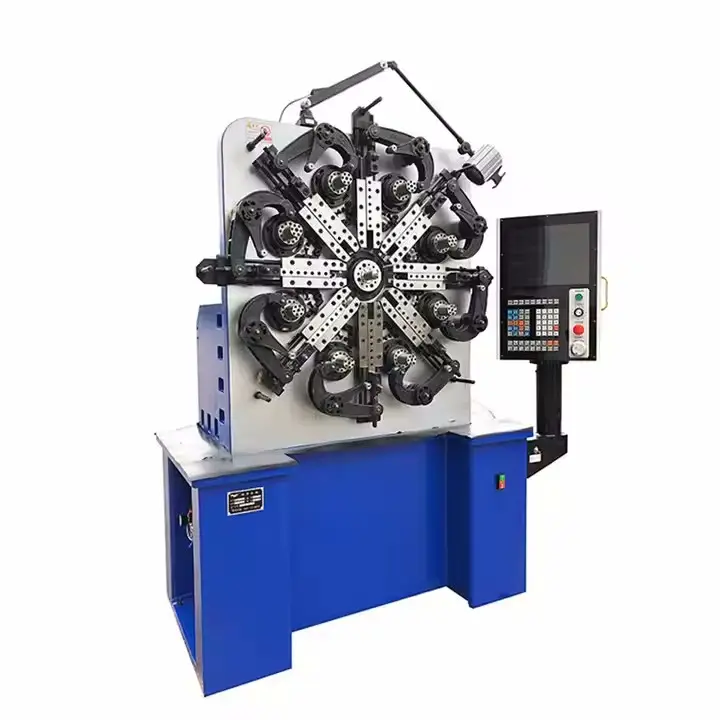
Closed-loop feedback is the foundation of consistent precision in modern computer-controlled spring machines. Unlike open-loop systems—which execute fixed commands without verifying outcomes—closed-loop architectures continuously measure actual tool position, wire feed, and coil pitch using high-resolution encoders and linear scales. These sensors feed real-time data to the digital controller, which compares each measurement against the target CAD geometry. When deviations arise—whether from thermal expansion, tool wear, or wire elasticity—the system triggers servo-driven corrections within milliseconds, preventing errors before they manifest as defects. This dynamic regulation sustains dimensional accuracy within ±2 microns across tens of thousands of cycles (Precision Engineering Journal, 2023). Because correction occurs at the drive level, critical parameters like coil diameter, free length, and pitch remain stable—even when raw material properties vary. The outcome is a sharp reduction in out-of-spec parts, directly elevating first-pass yield and minimizing rework or scrap.
Statistical yield comparison: computer controlled spring machine (92.4%) vs. manual/semi-auto spring machine (76.1%)
Yield performance captures the tangible impact of closed-loop precision. A 2023 industry benchmark study by the Spring Manufacturers Institute found that computer-controlled spring machines achieve a 92.4% first-pass yield—significantly higher than the 76.1% yield typical of manual or semi-automatic setups.
| Machine Type | First-Pass Yield Rate |
|---|---|
| Computer-controlled spring machine | 92.4% |
| Manual or semi-auto spring machine | 76.1% |
Source: Spring Manufacturers Institute Benchmark, 2023
That 16.3-percentage-point gap translates to measurable operational value: for a standard batch of 10,000 springs, the computer-controlled line delivers 9,240 conforming units versus just 7,610 from manual production—a difference of 1,630 additional good parts per run. These extra units avoid material waste, energy use, and labor spent on non-value-added rework. Higher yield also means fewer quality interruptions, reduced inspection burden, and lower scrap disposal costs—turning precision engineering into sustained profitability.
Optimized Production Workflow Boosts Spring Machine Uptime and Efficiency
Integrating digital control and automation across the spring manufacturing chain dramatically improves uptime and efficiency. By unifying design, planning, and execution through a shared data backbone, modern spring machine systems eliminate manual handoffs and bottlenecks that traditionally slow output. Real-time adjustments, minimized idle time, and uninterrupted part flow—from forming through heat treatment and finishing—drive higher overall equipment effectiveness (OEE) and reduce micro-stoppages.
Cycle time reduction through integrated digital spring manufacturing workflows
Digital workflows converge CAD data, real-time process monitoring, and adaptive motion control into a single closed-loop system. Equipped with this capability, a spring machine automatically optimizes feed rates, coiling parameters, and cut positions—reducing cycle time without compromising quality. Industrial automation studies confirm that fully integrated lines operate three to five times faster than semi-automatic setups while cutting dimensional defects by up to 60%. These gains stem from eliminating manual coordinate entry and trial-and-error setup. In practice, manufacturers adopting digital spring machine networks report more than a one-third reduction in cycle time per part—enabling higher daily output within the same floor space and labor footprint. The continuous data stream also powers predictive maintenance algorithms, further reducing unplanned downtime.
AI-driven setup automation cutting spring machine changeover time by up to 40%
Changeover delays are a major source of lost uptime—especially in low-volume, high-mix environments. AI-powered setup automation addresses this by learning optimal tool positioning, feed sequences, and forming speeds from historical production data. When a new order arrives, the system matches part requirements against stored profiles and generates a validated, ready-to-run configuration in seconds—replacing hours of manual trial-and-error. Industry analyses show that camless spring machines combined with AI-driven parameter optimization achieve up to a 40% reduction in changeover time while maintaining tolerances within 0.02 mm. This speed allows operators to focus on final verification rather than setup, maximizing productive machine hours per shift. The result is a leaner, more responsive operation capable of adapting swiftly to demand fluctuations.
Consistent Spring Quality Across High-Volume Runs
Tight-tolerance validation: 0.02mm repeatability sustained over 10,000+ parts on smart spring machinery
Sustaining uniform quality during extended production runs is a hallmark of computer-controlled spring manufacturing. Smart spring machines rely on closed-loop feedback—not operator consistency—to maintain exact geometries. Validation confirms these systems hold a repeatability tolerance of 0.02 mm across 10,000+ consecutive parts—a level essential for mission-critical applications in automotive valves and medical devices. Real-time force and dimension monitoring compensates for material variability, contributing directly to the 92.4% first-pass yield rate documented in industry benchmarks. Integrated statistical process control (SPC) tools capture data from every coil, enabling full traceability and reinforcing quality assurance without manual intervention. Because the system continuously self-corrects, manufacturers avoid frequent recalibration and routine manual checks—streamlining workflow while delivering defect-free springs at scale.
FAQ
What is closed-loop feedback?
Closed-loop feedback is a technology that continuously measures and adjusts machine settings in real-time to ensure precision, eliminating errors due to factors like thermal expansion, tool wear, or material variability.
How does computer-controlled spring manufacturing improve yield?
Computer-controlled systems maintain higher accuracy and consistency, achieving a first-pass yield of 92.4%, compared to 76.1% for manual systems, significantly reducing defects and production waste.
What are the benefits of AI-driven setup automation?
AI-driven setup automation dramatically cuts changeover times by up to 40%, enabling faster production with minimal errors, especially in low-volume, high-mix manufacturing environments.
How does digital integration enhance spring manufacturing workflows?
Digital integration unifies design, real-time monitoring, and adaptive control in a single system, reducing cycle times, defects, and inefficiencies while boosting uptime.
What is the importance of 0.02 mm repeatability in spring manufacturing?
This level of precision ensures consistent quality over large production runs, making it essential for critical applications like automotive and medical industries.