EN
EN

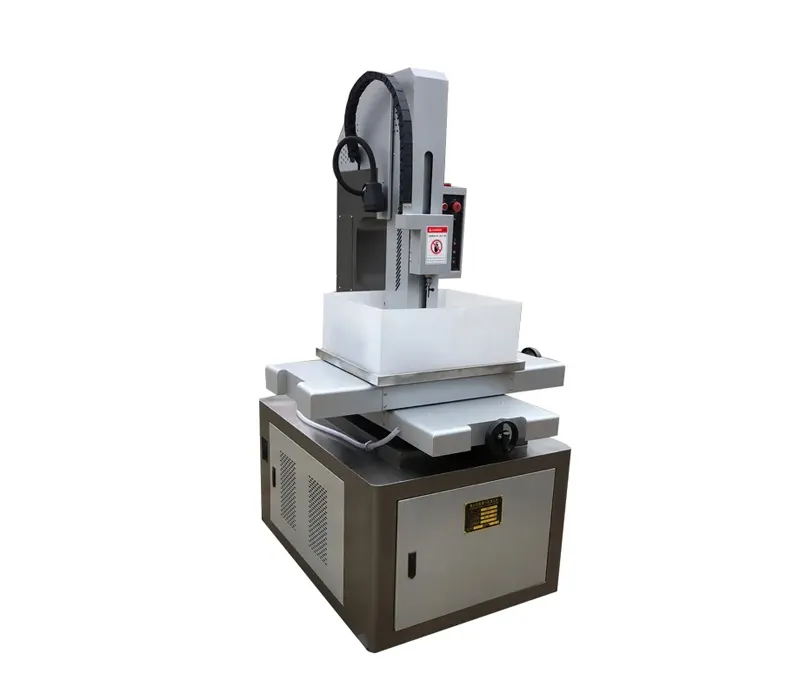
Chemical Industry Mold Challenges Demand Corrosion-Resistant EDM Drilling Machines
Aggressive chemical environments degrade conventional tooling and accelerate EDM component failure
Chemical manufacturing environments subject mold tooling to a relentless assault. Chlorinated hydrocarbons, acidic process vapors, and aggressive cleaning agents don’t just attack the mold cavity surface—they infiltrate the machine itself. Standard EDM drilling machines built with brass fittings, carbon steel guide rails, and off-the-shelf seals suffer accelerated degradation. Pitting on electrode holders from hydrochloric acid fumes causes concentricity errors; solvent-induced swelling of dielectric circuit seals introduces contamination directly into the spark gap. This cascade increases unscheduled maintenance by 30–40% compared to neutral environments—eroding process capability and driving up total cost of ownership. The cumulative impact of unplanned downtime, component replacement, and scrap can reach $740 k annually (Ponemon Institute, 2023). Addressing this requires a fundamental shift: from general-purpose to purpose-built anti-corrosion machine architectures where every fluid-contact and air-exposed component is specified for long-term chemical resistance.
Electrochemical compatibility: How passive oxide layers on molds require non-reactive EDM architecture
High-performance mold materials like 316L stainless steel and Hastelloy C-276 rely on a nanoscale (2–5 nm) chromium-rich passive oxide layer for corrosion resistance—a fragile electrochemical barrier. Crucially, the EDM drilling machine itself must not act as a counter-electrode that destabilizes this layer. In humid, acidic atmospheres, copper or brass components on standard machines can form galvanic couples with the workpiece, turning the precision mold into a sacrificial anode. Micro-galvanic corrosion initiates at the machining site, causing sub-surface damage that later manifests as pitting in service. A truly non-reactive EDM architecture eliminates this risk through strategic material selection: titanium alloy frames, electropolished stainless steel work tanks, and ceramic-coated guide systems. By ensuring electrochemical nobility across the entire machine-workpiece interface, the system preserves the mold’s foundational corrosion resistance—so the process of making a corrosion-resistant part doesn’t inadvertently compromise it.
How Anti-Corrosion EDM Drilling Machines Enable Reliable Machining of Chemically Resistant Alloys
Titanium-coated electrode holders and optimized dielectric fluids prevent galvanic corrosion in 316L stainless steel and Inconel 718 molds
Galvanic corrosion arises when dissimilar metals contact a conductive dielectric—especially problematic in EDM drilling of 316L stainless steel and Inconel 718. Standard steel electrode holders can act as sacrificial anodes, degrading mold surfaces during operation. Titanium-coated holders—applied via physical vapor deposition (PVD)—create a chemically inert, wear-resistant barrier that halts ion transfer and protects the base metal across thousands of drilling cycles.
Complementing this, modern dielectric fluids incorporate corrosion inhibitors like benzotriazole, which form self-healing monolayers on metal surfaces. These films neutralize free radicals, suppress chloride adsorption, and prevent pitting—even in high-chloride environments. While 316L’s low carbon content reduces sensitization risk, and Inconel 718’s nickel-chromium matrix resists oxidation, both remain vulnerable to localized corrosion during EDM if fluid chemistry and electrode materials are mismatched. The synergy of titanium-coated holders and tailored dielectrics ensures mold integrity is preserved: dimensional accuracy, surface finish, and electrochemical stability remain uncompromised. As a result, molds for aggressive chemical media deliver repeatable, long-life performance without post-machining rework.
Zero Mechanical Stress: The Critical Advantage of EDM Drilling Machine Precision for Heat-Treated Mold Steels
Heat-treated mold steels—often hardened to 60 HRC or beyond—are essential for chemical-industry tooling requiring sustained corrosion resistance. Traditional machining introduces cutting forces that induce micro-cracks, distortion, or residual stress, undermining fatigue life and corrosion performance. EDM drilling eliminates these risks entirely: the electrode never contacts the workpiece, so the process exerts zero mechanical stress. This non-contact principle is indispensable for thin-walled sections, intricate cooling channels, and ultra-hard alloys where even micron-level deflection could trigger premature failure.
Because no force is transmitted, the steel’s heat-treated properties—hardness, microstructure, and dimensional stability—remain fully intact. Mold makers can drill precise, burr-free holes directly into hardened material without secondary stress-relieving, re-tempering, or polishing. The absence of tool pressure also prevents electrode breakage in deep or small-diameter holes, ensuring consistent hole geometry and surface integrity across production runs. For chemical processing molds—where every micro-fissure is a potential initiation site for crevice corrosion—the stress-free nature of EDM drilling translates directly into longer service life, higher safety margins, and more reliable mold performance.
Why EDM Drilling Machines Outperform Milling in Corrosion-Critical Applications Like Hastelloy C-276 Mold Cavities
Debunking the conductivity myth: Real corrosion risk stems from dielectric residue and electrode material mismatch—not electrical discharge itself
A persistent misconception holds that the electrical spark in EDM inherently corrodes mold material. In reality, the process occurs under tightly controlled dielectric fluid that insulates and cools, preventing oxidation during discharge. The true corrosion risks for alloys like Hastelloy C-276 arise after machining: from residual dielectric trapped in cavities—harboring aggressive ions—and from galvanic coupling between electrode and workpiece. For example, copper electrodes can leave microscopic deposits on Hastelloy surfaces, establishing local cells that accelerate pitting upon exposure to acidic process media.
Modern anti-corrosion EDM drilling machines mitigate both risks: integrated high-efficiency filtration removes >99.9% of particulate and ionic residue, while dielectric formulations with low chloride content and neutral pH eliminate reactive contaminants. Pairing these with non-galvanic electrodes (e.g., graphite or titanium-coated copper) further eliminates electrochemical mismatch. In contrast, milling introduces unavoidable mechanical stress—surface work hardening, micro-cracking, and thermal distortion—all of which create preferential sites for crevice and stress corrosion cracking. An EDM drilling machine, when configured with compatible electrodes and followed by validated cleaning protocols, delivers a defect-free, stress-neutral surface—making it the only viable option for maintaining the full corrosion resistance of premium alloys like Hastelloy C-276 in mission-critical chemical applications.
FAQ
1. Why do standard EDM drilling machines fail in chemical manufacturing environments?
Standard EDM drilling machines use materials like brass and carbon steel, which corrode faster when exposed to acidic fumes, chlorinated hydrocarbons, and cleaning agents, causing component degradation and increased maintenance.
2. How do anti-corrosion EDM drilling machines address galvanic corrosion?
They feature titanium-coated electrode holders, corrosion-inhibiting dielectric fluids, and non-reactive machine components to prevent galvanic couples and eliminate risks of sub-surface mold damage.
3. Are EDM drilling machines better suited for heat-treated mold steels?
Yes, because EDM drilling exerts zero mechanical stress, preserving the hardness and dimensional stability of heat-treated steels and avoiding micro-cracks or residual stress.
4. What are the risks of using copper electrodes for Hastelloy C-276 molds?
Copper electrodes can leave deposits, forming local galvanic cells that lead to pitting corrosion when exposed to acidic environments. Non-galvanic electrodes mitigate this issue effectively.
Table of Contents
- Chemical Industry Mold Challenges Demand Corrosion-Resistant EDM Drilling Machines
- How Anti-Corrosion EDM Drilling Machines Enable Reliable Machining of Chemically Resistant Alloys
- Zero Mechanical Stress: The Critical Advantage of EDM Drilling Machine Precision for Heat-Treated Mold Steels
- Why EDM Drilling Machines Outperform Milling in Corrosion-Critical Applications Like Hastelloy C-276 Mold Cavities
-
FAQ
- 1. Why do standard EDM drilling machines fail in chemical manufacturing environments?
- 2. How do anti-corrosion EDM drilling machines address galvanic corrosion?
- 3. Are EDM drilling machines better suited for heat-treated mold steels?
- 4. What are the risks of using copper electrodes for Hastelloy C-276 molds?