EN

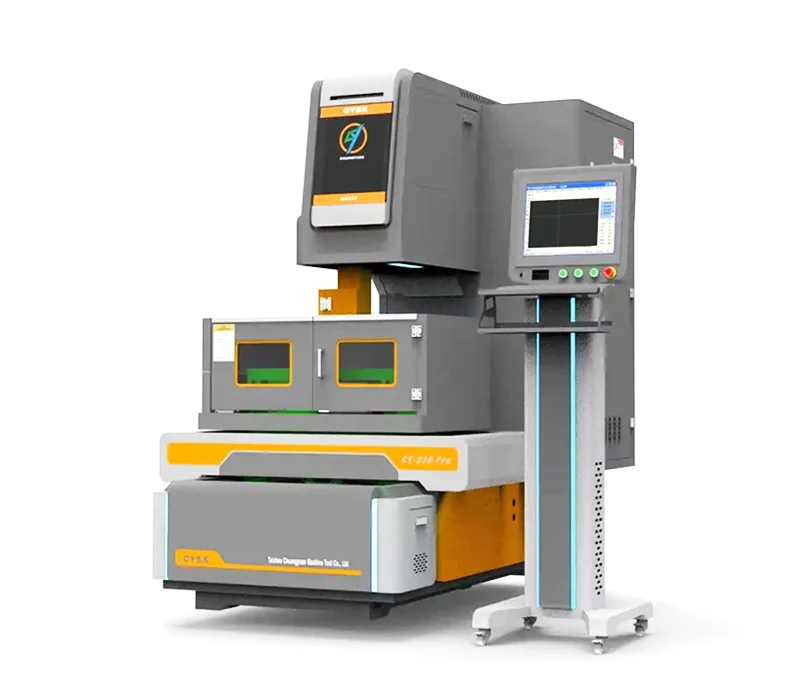
Why Wire Cutting Machine Precision Directly Determines Mold Surface Finish Quality
The surface integrity of a mold cavity is not merely a cosmetic attribute—it directly governs part release, dimensional fidelity, and tool longevity. In a modern mold workshop, the wire cutting machine stands as the critical arbiter of surface quality, where micron-level deviations can cascade into scrap and costly rework. The following two domains illustrate how this precision is achieved and maintained.
Sub-Micron Accuracy in Die/Mold Cavities: How Wire EDM Enables Zero-Defect Surface Integrity
Achieving zero-defect surface integrity in die and mold cavities demands a wire cutting machine operating at the edge of physical limits. Wire EDM erodes material through thousands of non-contact electrical discharges per second—eliminating mechanical stress that could distort delicate geometries. While standard wire EDM holds dimensional accuracy to ±0.01 mm, staged finishing passes can refine surface roughness to Ra 0.5 µm or finer—a near-sub-micron finish. This topography minimizes ejection friction, reduces stress-concentration points that initiate cracks, and prevents adhesion of molten plastics or metals. Crucially, the non-contact process enables precise cutting of hardened tool steels above 60 HRC without compromising edge integrity. Under optimized conditions, the recast layer remains under 5 µm, preserving bulk material properties and ensuring faithful replication of design features—flatness, sharp corners, and fine ribs—all within a few microns.
Key Process Parameters Affecting Finish: Pulse Settings, Wire Tension, and Flushing Efficiency
Three interdependent parameters—pulse settings, wire tension, and flushing efficiency—define final surface quality in wire-cut molds. Shorter, lower-energy pulses produce finer finishes but reduce cutting speed; balancing this trade-off is essential for high-value mold components. Wire tension—typically maintained between 15 and 25 Newtons—suppresses vibration and deflection that cause waviness or taper; insufficient tension leads to wire wander, degrading both surface finish and geometric accuracy. Flushing efficiency ensures consistent dielectric strength by cooling the cut zone and evacuating debris. When particle contamination exceeds 60 µm, spark efficiency drops by ~30%, increasing micro-pitting risk. Advanced machines monitor and adapt flushing pressure in real time to sustain laminar flow. Optimizing all three parameters enables repeatable surface roughness below Ra 1 µm—even on complex, high-precision mold features.
Optimizing Mold Workshop Workflow with Smart Wire Cutting Machine Integration
The shift toward smart manufacturing in mold workshops relies on wire cutting machines that not only cut with precision but also integrate seamlessly into digital workflows. Two key technologies—real-time gap voltage control and CAD/CAM-driven path optimization—are reshaping how shops achieve consistent quality and reduced lead times.
Real-Time Gap Voltage Control for Stable Dimensional Output Across Mold Components
Maintaining uniform spark gap voltage is critical for consistent erosion and dimensional accuracy in wire EDM. Smart machines use closed-loop feedback systems to continuously monitor gap conditions and adjust pulse parameters in real time—preventing short circuits and arcing that cause localized overheating and surface defects. Research published in the International Journal of Machine Tools and Manufacture (2023) shows this adaptive control reduces dimensional variation by up to 30% across multi-cavity molds. By dynamically tuning pulse on-time, off-time, and peak current—and coupling it with adaptive flushing pressure—machines sustain stable discharge gaps even when cutting variable thicknesses or intricate geometries. The result is repeatable tolerances within ±2 µm, minimizing rework and enabling zero-defect production. Operators shift from active intervention to strategic oversight, transforming wire EDM from a programmable process into an intelligent manufacturing cell.
CAD/CAM-Driven Path Optimization: Reducing Recuts and Enhancing Geometric Fidelity
CAD/CAM integration eliminates manual programming errors and streamlines toolpath generation. Advanced algorithms analyze part geometry to minimize idle travel, avoid unnecessary recuts, and preserve corner fidelity—reducing cycle times by up to 25% while maintaining surface finish (SME Technical Paper, 2023). Digital twin simulations verify cutting sequences virtually before production, preventing collisions and material waste. Smart wire cutting machines import CAM data directly, enabling automatic wire threading and adaptive path adjustments based on real-time erosion feedback. This ensures high-fidelity mold cavities with fewer secondary finishing operations. Reduced recuts also lower wire consumption and extend guide component life—contributing directly to workflow efficiency. Ultimately, CAD/CAM-driven optimization supports lights-out manufacturing: complex mold components produced overnight with minimal human intervention and consistent, predictable quality.
Maintaining Long-Term Wire Cutting Machine Performance for Consistent Mold Quality
Critical Maintenance Factors: Deionized Water Conductivity, Filter Lifespan, and Electrode Wire Selection
Consistent mold quality hinges on three interconnected maintenance factors that directly influence wire cutting repeatability. First, deionized water conductivity must be tightly controlled—deviation beyond the recommended 5–15 µS/cm range alters spark gap dynamics and introduces unpredictable surface finishes. Even a 2 µS/cm drift can shift material removal rates enough to compromise critical cavity details. Second, filter lifespan dictates dielectric cleanliness; saturated filters recirculate microscopic debris that destabilizes discharges and causes micro-pitting. Leading workshops replace cartridge filters based on real-time pressure differentials—not fixed hour intervals—to prevent the 25% drop in flushing efficiency that accelerates electrode wire wear. Third, electrode wire selection balances tensile strength and electrical conductivity. While brass wires suffice for general applications, zinc-coated or diffusion-annealed wires reduce recast layer thickness by up to 30% in hard die steels, preserving edge integrity over thousands of cycles. A preventive regimen tracking conductivity logs, filter pressure curves, and wire consumption patterns reduces unplanned downtime and sustains single-digit micron surface consistency year after year.
FAQs
Why is wire cutting machine precision critical for mold surface quality?
Wire cutting machine precision determines surface finish quality by ensuring dimensional integrity and eliminating defects like micro-pitting and irregularities. This precision directly impacts mold functionality and lifespan.
How does real-time gap voltage control enhance dimensional accuracy in wire EDM?
Real-time gap voltage control adjusts pulse parameters dynamically, maintaining stable discharge gaps and preventing defects like overheating. This leads to repeatable tolerances and consistent surface finish.
What role does CAD/CAM play in optimizing wire cutting?
CAD/CAM streamlines toolpath generation, reduces manual errors, and ensures geometric fidelity through digital simulations. It enhances efficiency and reduces the need for recuts in wire EDM processes.
What maintenance factors are essential for consistent mold quality?
Key factors include proper deionized water conductivity, timely filter replacement, and selecting the right electrode wires. Maintaining these elements ensures repeatable surface quality and reduces unplanned downtime.