EN

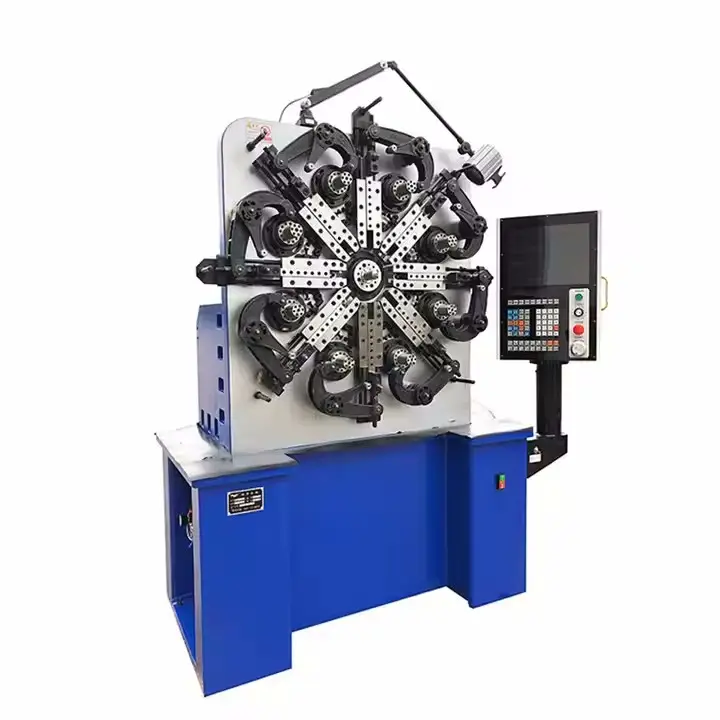
Core Mechanical Advantages of Servo-Driven Spring Machines
Eliminating Mechanical Backlash: Servo vs. Cam-Based Spring Machine Architectures
Traditional cam-driven spring machines rely on mechanical cams, gears, and linkages to coordinate forming actions—components inherently susceptible to wear. Over time, this wear introduces backlash: cumulative clearance between mating parts that degrades positioning accuracy and causes drift during high-volume production. Servo-driven spring machines eliminate these rigid transmission chains entirely. Each forming axis is powered by a dedicated servo motor in a direct-drive configuration—removing gear trains, cam profiles, and the associated sources of lost motion and hysteresis.
This architecture ensures commanded positions are executed precisely and without delay. Dimensional control tightens across every coil, and precision remains stable over thousands of cycles with minimal maintenance. Unlike cam-based systems—where retooling a new spring design requires hours of physical cam swaps and linkage adjustments—servo machines execute changeovers in seconds via software. A new program loads, and axes adapt instantly. By removing mechanical backlash—the weakest link in legacy architectures—servo-driven spring machines deliver consistent quality from first part to last.
Real-Time Position Feedback and Sub-Micron Repeatability in Spring Forming
Precision in spring manufacturing demands more than backlash elimination—it requires continuous verification and correction. Servo-driven spring machines integrate high-resolution rotary or linear encoders that feed real-time position data to the CNC controller. This closed-loop system compares actual axis position against target coordinates thousands of times per second, correcting deviations caused by wire tension fluctuations or minor mechanical deflections.
The result is sub-micron repeatability: the ability to return to an identical forming coordinate with error measured in fractions of a micron. That level of fidelity is essential for miniature springs—such as those made from 0.1 mm wire—where variations of just a few microns can shift spring rate or free length beyond specification. Real-time feedback also enables dynamic compensation for tool wear: as coiling points erode, the controller automatically adjusts axis offsets to preserve geometry. Manufacturers report fewer rejected parts and extended tool life. Servo drives thus deliver not only speed and automation but verifiable, sustained precision—non-negotiable for high-integrity spring applications.
Superior Actuation: Why Servo Motors Outperform Hydraulic and Pneumatic Drives in Spring Machines
Torque Linearity and Millisecond Response for High-Frequency Coiling Cycles
Servo motors excel in high-frequency coiling because they deliver full-rated torque from zero speed and maintain it linearly across the entire velocity range. Hydraulic systems suffer from fluid compressibility, causing response delays and torque falloff at high flow rates. Pneumatic actuators lack fine force control and struggle to hold sub-millimeter feed positions due to air compressibility and leakage.
A servo axis responds to position commands in under 5 milliseconds—enabling instantaneous, overshoot-free adjustments to feed length or coiling point. This responsiveness allows machines to sustain over 300 cycles per minute while holding wire advance accuracy to ±0.02 mm, even amid fluctuating material tension. The direct-drive architecture eliminates gear shear and backlash, ensuring every millisecond contributes productively to the coiling cycle. In contrast, hydraulic and pneumatic systems cannot match this combination of rapid acceleration, steady forming force, and zero reset time—making servo actuation indispensable for precision spring manufacturing.
Thermal Stability and Energy Efficiency During Extended Spring Machine Operation
Thermal drift is a major threat to dimensional consistency in long production runs. Servo motors generate heat only when actively producing torque; during idle or low-load phases, power draw drops significantly. This on-demand energy use stands in stark contrast to hydraulic pumps—which run continuously, dissipating excess flow as waste heat and often requiring external chillers that consume floor space and increase energy costs.
Field data from high-volume coiling operations show servo-driven spring machines consume 30–50% less electricity than comparable hydraulic units over an 8-hour shift. Reduced heat generation means the machine frame, mandrels, and tooling remain thermally stable—minimizing expansion-related shifts in coil diameter (which can exceed 5–10 microns under thermal stress). Pneumatic systems compound inefficiency through air compression losses and unpredictable exhaust heat dissipation. With servo actuation, tight tolerance bands are sustained hour after hour. Regenerative braking further enhances efficiency by returning surplus kinetic energy to the drive system. This intrinsic thermal stability and energy intelligence make servo-based machines the preferred choice for unattended, long-duration coiling runs.
Empirical Evidence: Precision Metrics Across Spring Machine Types
Case Study: 0.12mm Wire Compression Spring Production — Dimensional Stability Over 1,200 Parts
In a controlled production run of compression springs made from 0.12 mm wire, a servo-driven spring machine held free length variation within ±0.003 mm across 1,200 consecutive parts. An equivalent cam-operated machine exhibited drift exceeding ±0.015 mm after only 300 coils—failing to meet tight tolerance requirements. The servo system maintained pitch uniformity at wire feed rates up to 80 m/min while dynamically compensating for progressive tool wear. Measurements were performed using a traceable laser micrometer. After eight hours of continuous operation, statistical analysis confirmed a standard deviation of just 1.2 microns—demonstrating verified sub-micron repeatability. This stability eliminates secondary sorting and reduces scrap by over 40%, aligning with industry benchmarks where CNC spring machine repeatability typically reaches ±0.005 mm. For high-reliability applications—including medical devices—this precision ensures consistent force characteristics across every spring.
Future-Proofing Precision: Industry 4.0 Integration in Modern Spring Machines
Adaptive Closed-Loop Control for Material Variability and Tool Wear Compensation
Modern servo-driven spring machines embed adaptive closed-loop control systems that monitor forming force and wire position in real time. When material hardness shifts or tool edges wear, the controller autonomously adjusts feed rate, coiling angle, and cut-off timing—maintaining dimensional accuracy within microns without manual intervention. This intelligence eliminates routine recalibration and dramatically reduces scrap, enabling one machine to handle batch-to-batch wire variability with confidence.
As of 2025, such capabilities transform each production run into a self-optimizing process—future-proofing precision for high-mix, low-volume spring manufacturing. By integrating seamlessly with factory-wide data networks, these systems support predictive maintenance, remote diagnostics, and real-time quality analytics—extending the value of precision engineering well beyond the shop floor.
Frequently Asked Questions
What is mechanical backlash in spring machines?
Mechanical backlash refers to cumulative clearance between mating parts within mechanical systems, such as cams and gears, that introduce inaccuracies in positioning or motion.
Why are servo-driven spring machines more precise?
Servo-driven spring machines eliminate mechanical components prone to wear, integrate real-time position feedback, and ensure sub-micron motion repeatability for sustained precision.
How do servo spring machines manage thermal stability?
Servo motors generate heat only during active torque production, reducing thermal drift. Additionally, energy efficiency minimizes heat generation during long production runs.
What are Industry 4.0 integrations in spring machines?
Industry 4.0-enabled spring machines include adaptive closed-loop control systems, predictive maintenance, real-time quality analytics, and seamless integration into factory-wide data networks.
How do servo motors compare to hydraulic systems in spring manufacturing?
Servo motors provide faster response times, linear torque delivery, and greater energy efficiency, whereas hydraulic systems suffer from fluid compressibility delays and excessive heat dissipation.
Table of Contents
- Core Mechanical Advantages of Servo-Driven Spring Machines
- Superior Actuation: Why Servo Motors Outperform Hydraulic and Pneumatic Drives in Spring Machines
- Empirical Evidence: Precision Metrics Across Spring Machine Types
- Future-Proofing Precision: Industry 4.0 Integration in Modern Spring Machines
- Frequently Asked Questions