EN
EN

Production Bottlenecks of Traditional Integrated Spring Forming Equipment
Modern metal forming manufacturing increasingly features diversified product specifications and mixed batch production. Many production facilities need to process springs with different wire diameters, forming angles and structural sizes within the same workshop space. Traditional spring machines adopt an integral frame and fixed cam linkage structure, where the internal mechanical stroke and forming mechanism are highly integrated with the equipment body.
From long-term field observation across multiple spring processing workshops, integral mechanical structures create obvious restrictions during cross-spec production adjustment work. Every shift between distinct spring specifications requires full disassembly and reassembly of multiple cams, sliding blocks and limit components. Repeated mechanical rearrangement shifts the original assembly benchmark of the equipment, which brings inconsistent forming states across follow-up production batches. Industry research released by the Global Manufacturing Technology Association points out that integral forming equipment struggles to match variable production demands, and rigid fixed construction stands as the core factor limiting flexible operation for facilities handling varied spring dimensions.
Modular Unit Structure Eliminates Mechanical Reconfiguration Barriers
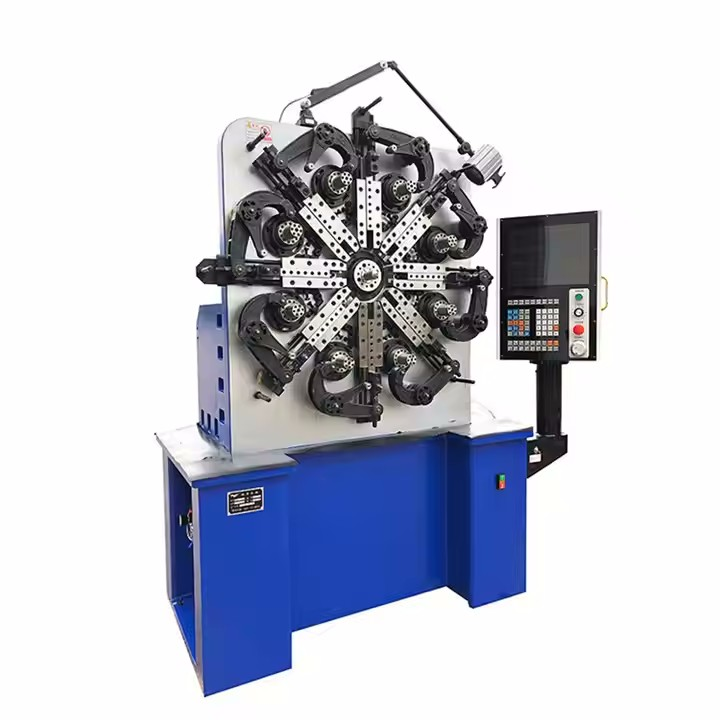
Modular spring machines restructure the internal mechanical layout of conventional forming equipment by splitting the complete forming system into multiple independent functional modules. Core assemblies covering wire feeding, straightening, bending, cutting and tension control are built as detachable, interchangeable standalone structures. Each module operates on separate servo control and positioning frameworks with no cross mechanical constraints between units.
This modular separation design reshapes the overall reconfiguration logic for spring processing work. When transitioning to spring goods with different structural requirements, production teams only adjust or replace targeted single functional modules, instead of taking apart the complete mechanical framework of the whole machine. Long-term data collected from workshop deployment records illustrates how modular construction cuts down the overall range of mechanical adjustments needed during product transitions. Such design also prevents assembly benchmark drift and unstable mechanical clearances brought on by large-scale disassembly, maintaining steady baseline operating conditions for equipment.
Digital Parameter Management Ensures Stable Cross-spec Production Conversion
Mechanical structural adjustment forms only one part of the full spec transition workflow. Unstable parameter matching acts as another primary source of inconsistent finished spring dimensions after product shifts. Traditional spring forming machines rely on manual note-taking and manual entry of processing figures. Frequent specification replacement brings repeated parameter edits, which easily create numerical deviations that disrupt uniform quality across production batches.
Modular spring machine systems carry a comprehensive digital parameter management platform. All mature processing parameter groups matched to various spring sizes can be stored permanently and retrieved on demand to align with active production plans. The unified central control system enables synchronized matching of multi-axis linkage data, and every functional module automatically adapts to new forming benchmarks once a stored product profile is selected. This standardized digital storage method removes human-input data errors, preserves consistent forming standards through every product transition, and delivers reliable technical foundations for mixed diversified production arrangements.
Universal Standard Interface Reduces Debugging and Matching Deviation
Hidden assembly mismatch errors after reinstallation represent an often overlooked downside of traditional spring machine spec changes. Most classic forming tool accessories use non-uniform custom connection ports. After disassembly and replacement, technical staff spend extended time running repeated stroke calibration and position correction to secure acceptable forming precision.
All functional modules and tool attachments fitted on modular spring machines follow unified industrial standard interfaces and fixed positioning benchmarks. Built-in standardized locking mechanisms guarantee identical assembly precision for each removable unit after countless rounds of disassembly and reinstallation. During continuous alternating production of multiple spring styles, standardised connection layouts remove redundant calibration steps, hold finished part dimensional tolerances within stable ranges, and raise overall controllability for workshops running mixed-type spring processing workflows.
Modular Maintenance Mechanism Optimizes Long-term Operational Stability
Continuous alternating production cycles and regular structural adjustments lead to natural gradual wear across mechanical components. For conventional integrated spring machines, aging in partial components disturbs the full machine operating state, and routine maintenance often demands full shutdown inspection that creates unnecessary operational interruptions.
Modular architecture separates easily worn functional units from the main machine frame. Daily inspection and component replacement work can target single independent modules without interfering with other connected functional structures. This targeted maintenance pattern slows the overall aging cycle of the full machine, sustains consistent long-term mechanical coordination precision, and lets production workshops retain balanced operating conditions through extended cycles of multi-spec alternating processing.
Professional Manufacturing Standards Sustain Modular Equipment Consistency
All flexible operational strengths delivered by modular spring machines rely on precise manufacturing protocols and unified structural matching standards. With more than twenty years of dedicated research, development and production experience covering metal processing machinery, CYMC has built refined production and calibration workflows dedicated to modular spring equipment.
Each individual functional module undergoes independent precision machining, single-unit testing and full linkage validation before shipment. Rigorous assembly rules and multi-layer quality inspection procedures secure interchangeability and matching accuracy for all modular assemblies. Supported by stable internal manufacturing infrastructure and a comprehensive complete product lineup, CYMC supplies reliable modular spring processing hardware to manufacturing operators worldwide, supporting steady, flexible multi-variety production layouts for long-term workshop operation.
Conclusion
Modular spring machine construction resolves a wide range of structural and technical constraints that limit traditional integrated forming equipment during alternating multi-spec production. Isolated mechanical modules, digital parameter storage frameworks and universal standard interface layouts collectively streamline the full adjustment process for switching between different spring product types, while targeted modular maintenance systems preserve consistent equipment performance over extended operation periods. For modern manufacturing facilities focused on flexible, diversified production arrangements, modular spring machines serve as stable core hardware to refine workshop layouts and sustain consistent processing quality across all product variants.
Table of Contents
- Production Bottlenecks of Traditional Integrated Spring Forming Equipment
- Modular Unit Structure Eliminates Mechanical Reconfiguration Barriers
- Digital Parameter Management Ensures Stable Cross-spec Production Conversion
- Universal Standard Interface Reduces Debugging and Matching Deviation
- Modular Maintenance Mechanism Optimizes Long-term Operational Stability
- Professional Manufacturing Standards Sustain Modular Equipment Consistency
- Conclusion